
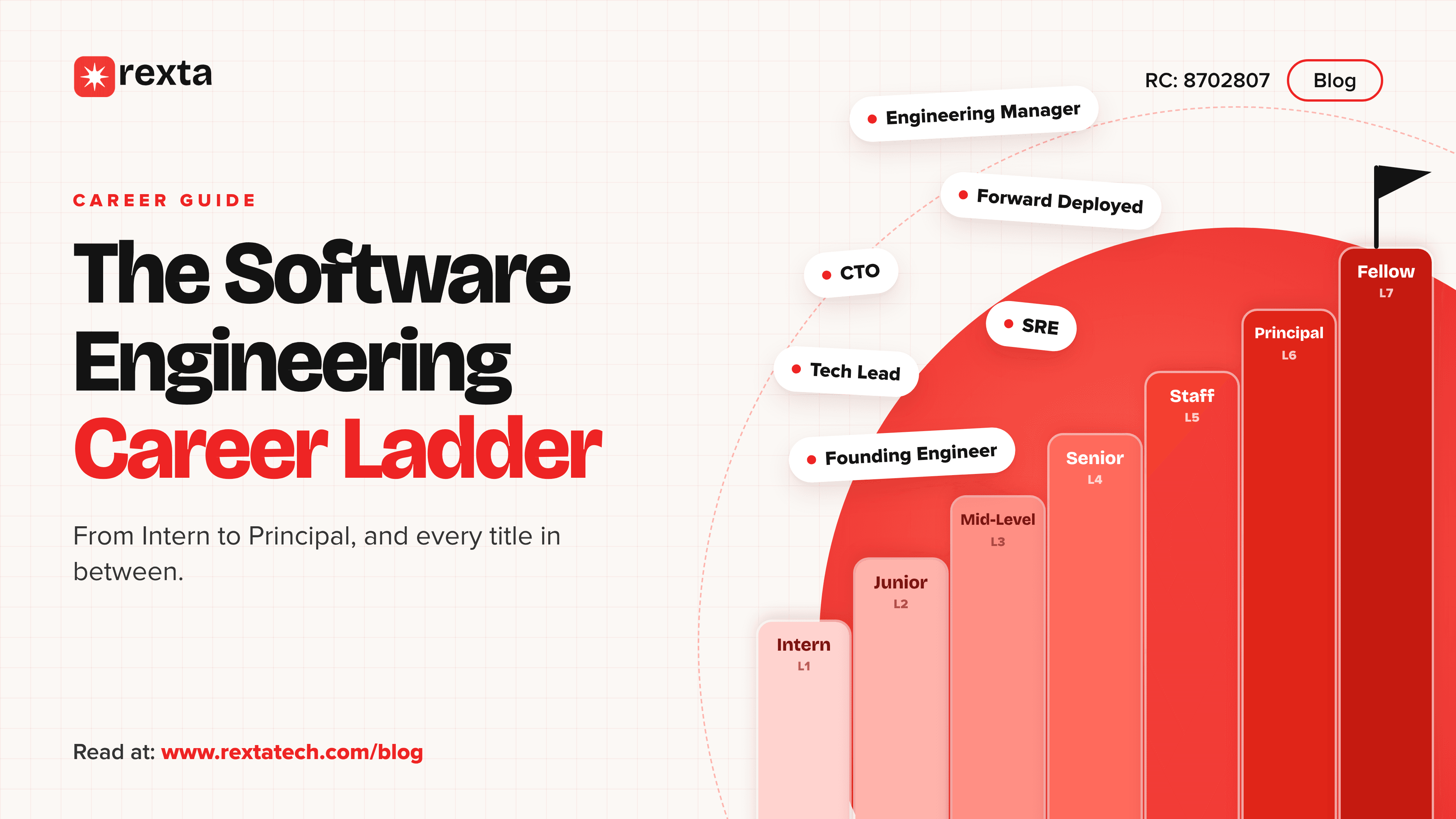
The Software Engineering Career Ladder
Open any tech job board and you'll see the same word dressed up a dozen different ways: Junior Software Engineer. Software Engineer II. Senior Engineer. Staff Engineer. Principal Engineer. Forward Deployed Engineer. Founding Engineer.
They all write code. So what's the difference?
The answer isn't how long someone has been coding or how fast they type. It's how much they own, how unclear their problems are, and how far their impact reaches. That is the software engineering career ladder, and once you understand it, job titles start to make sense.
This guide walks through every level, the two paths engineers can take, and the other titles you'll hear around tech.
What is a career ladder?
A career ladder is the set of levels a company uses to describe what's expected of engineers at each stage. It shapes how people are hired, reviewed, paid and promoted.
Two things are worth knowing before we start:
Titles aren't universal. A "Senior Engineer" at a five-person startup might be called "Mid-Level" at a large tech company. What matters is the scope of the work, not the word on the badge.
Many large companies use level codes. You'll see labels like L3 to L7 or E3 to E7 instead of titles. Sites like Levels.fyi map these codes across companies so you can compare like for like.
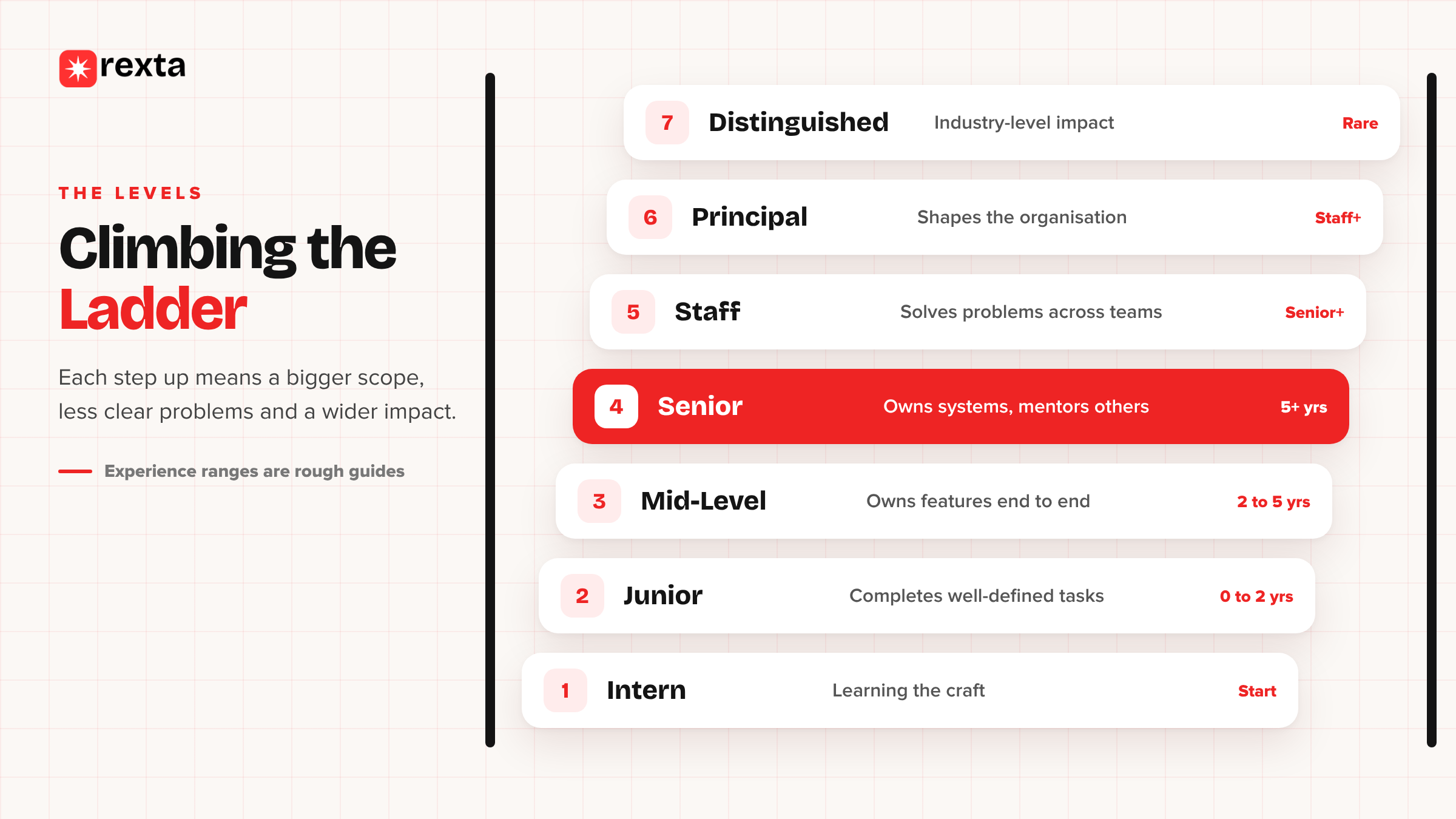
The levels, one by one
Intern / Trainee
Focus: learning. Interns work on real but carefully chosen tasks, with plenty of guidance. The goal is to learn how professional software is built: the tools, the codebase, the team's way of working.
Junior Engineer
Typical experience: 0 to 2 years
Focus: completing well-defined tasks. Junior engineers take clearly scoped work, such as fixing a bug or building a small part of a feature, and see it through with support. They ask a lot of questions, which is exactly what they should be doing.
Mid-Level Engineer
Typical experience: 2 to 5 years
Focus: owning features. A mid-level engineer can take a feature from idea to production with little supervision. They understand how their work fits into the wider system and need help mainly on unfamiliar or complex problems.
Senior Engineer
Typical experience: 5+ years
Focus: owning systems and raising the team. Seniors are trusted with the hard, unclear problems. They make technical decisions, review others' work, spot risks early and mentor less experienced engineers. A senior engineer makes the people around them better.
Staff Engineer
Focus: solving problems across teams. This is where the ladder changes shape. Staff engineers spend less time on their own team's tasks and more time on problems that span several teams: technical direction, architecture and the decisions that are expensive to get wrong. Will Larson's StaffEng is an excellent resource on what this level really looks like.
Principal Engineer
Focus: shaping the whole organization. Principal engineers set long-term technical strategy for large parts of the company. Their decisions affect how hundreds of engineers build software, sometimes for years.
Distinguished Engineer / Fellow
Focus: industry-level impact. The rarest level on the ladder, and most companies don't have it at all. These engineers are recognized experts whose work influences not only their company but the wider industry.
Experience ranges are rough guides, not rules. Some engineers reach Senior in four years; others take ten. Growth depends on the problems you work on, not just the time you spend.
What really changes as you move up
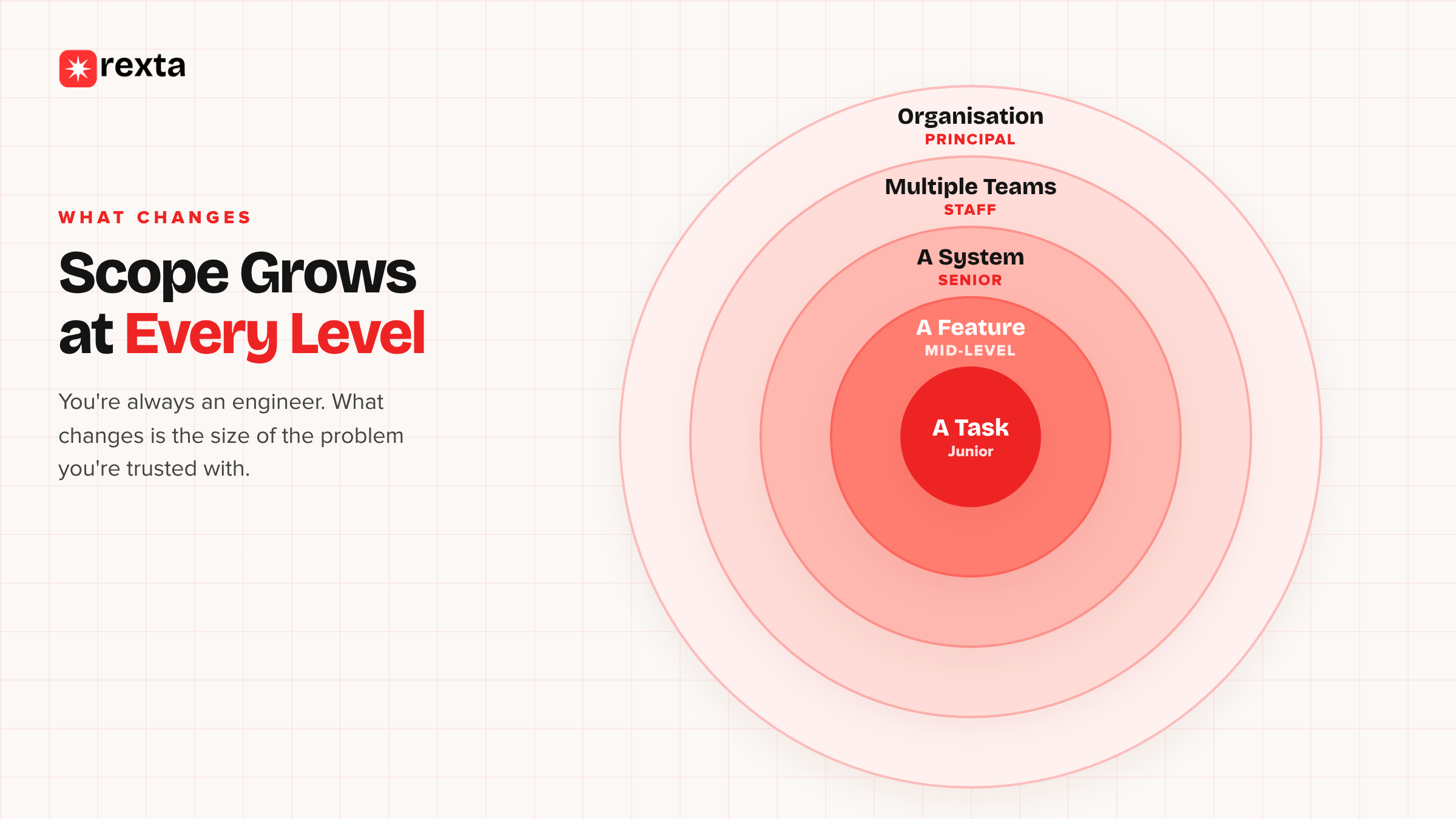
At every level you're still an engineer. What changes is the size of the problem you're trusted with.
Level | Scope | Ambiguity | Influence |
|---|---|---|---|
Junior | A task | Clear instructions | Your own work |
Mid-Level | A feature | Some unknowns | Your feature |
Senior | A system | Unclear problems | Your team |
Staff | Multiple teams | Problems no one has defined yet | Several teams |
Principal | The organization | Long-term, high-stakes decisions | The whole company |
In short: junior engineers are given problems to solve. Senior engineers find the right problems to solve. Staff and principal engineers decide which problems are worth solving at all.
Ready to take your first step on the ladder?
Meet Rexta Labs, our new training programme with hands-on courses in engineering, data, product and management. Learn from people who build software every day, and start your career with real skills.
Explore LabsTwo tracks: Individual Contributor vs Management
Somewhere around the senior level, most engineers reach a fork in the road.
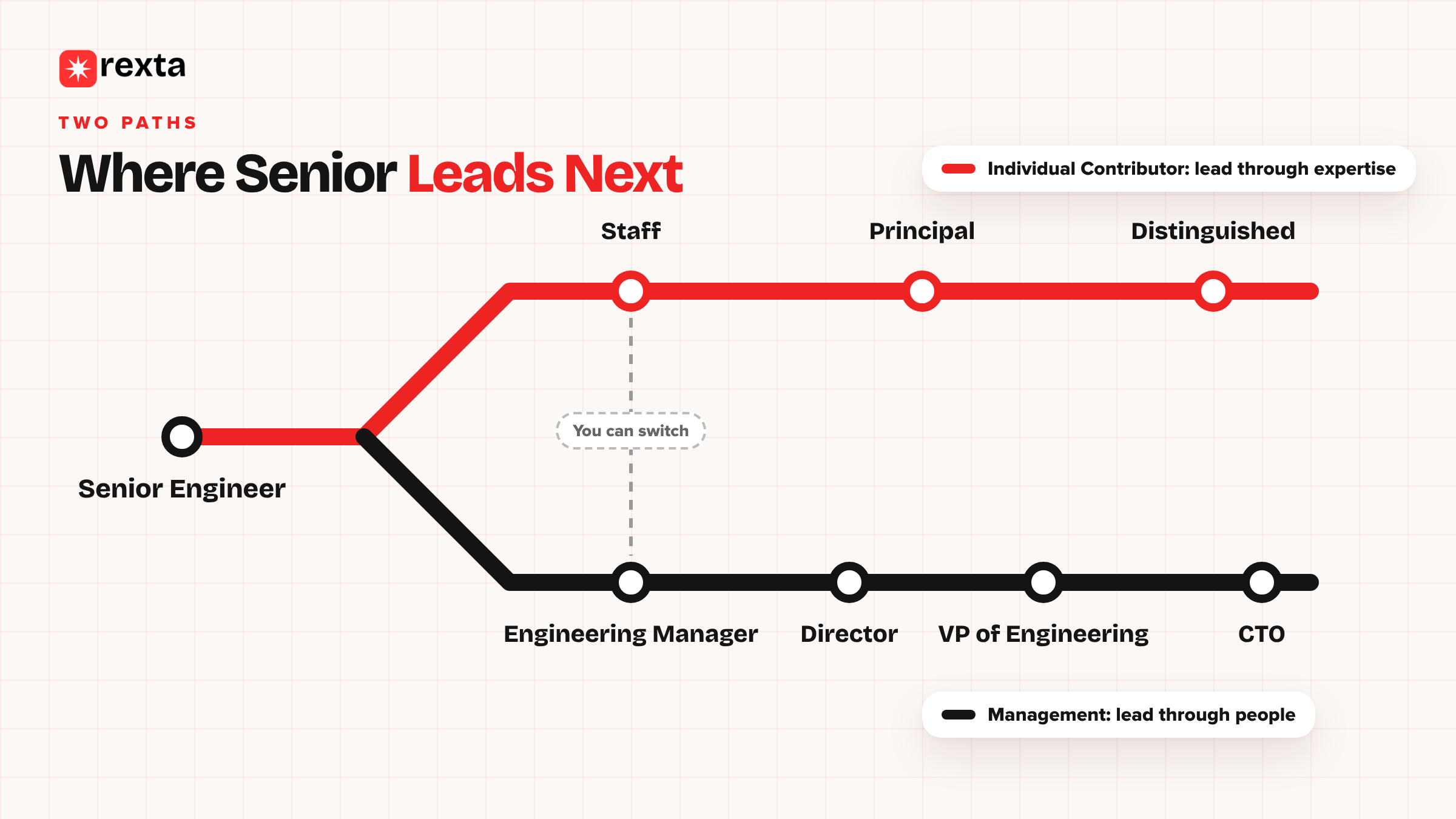
The Individual Contributor (IC) track keeps you hands-on. You grow by solving bigger technical problems and leading through expertise: Senior → Staff → Principal → Distinguished.
The management track shifts your focus to people. You grow by building and leading teams: Engineering Manager → Director of Engineering → VP of Engineering → CTO.
A few things are worth knowing:
Neither track is "higher". At good companies, a Staff Engineer and an Engineering Manager sit at a similar level, with similar pay and influence.
Management is a different job, not a promotion. You'll write less code and spend more time on hiring, feedback, planning and helping others do their best work.
You can switch. Many engineers move into management, then back to the IC track, and some go back and forth more than once. Charity Majors' essay on the engineer/manager pendulum is a great read on this.
Other titles you'll hear in tech
Not every title is a step on the ladder. Many describe the type of work an engineer does, and someone in these roles can be at any level from mid to principal.
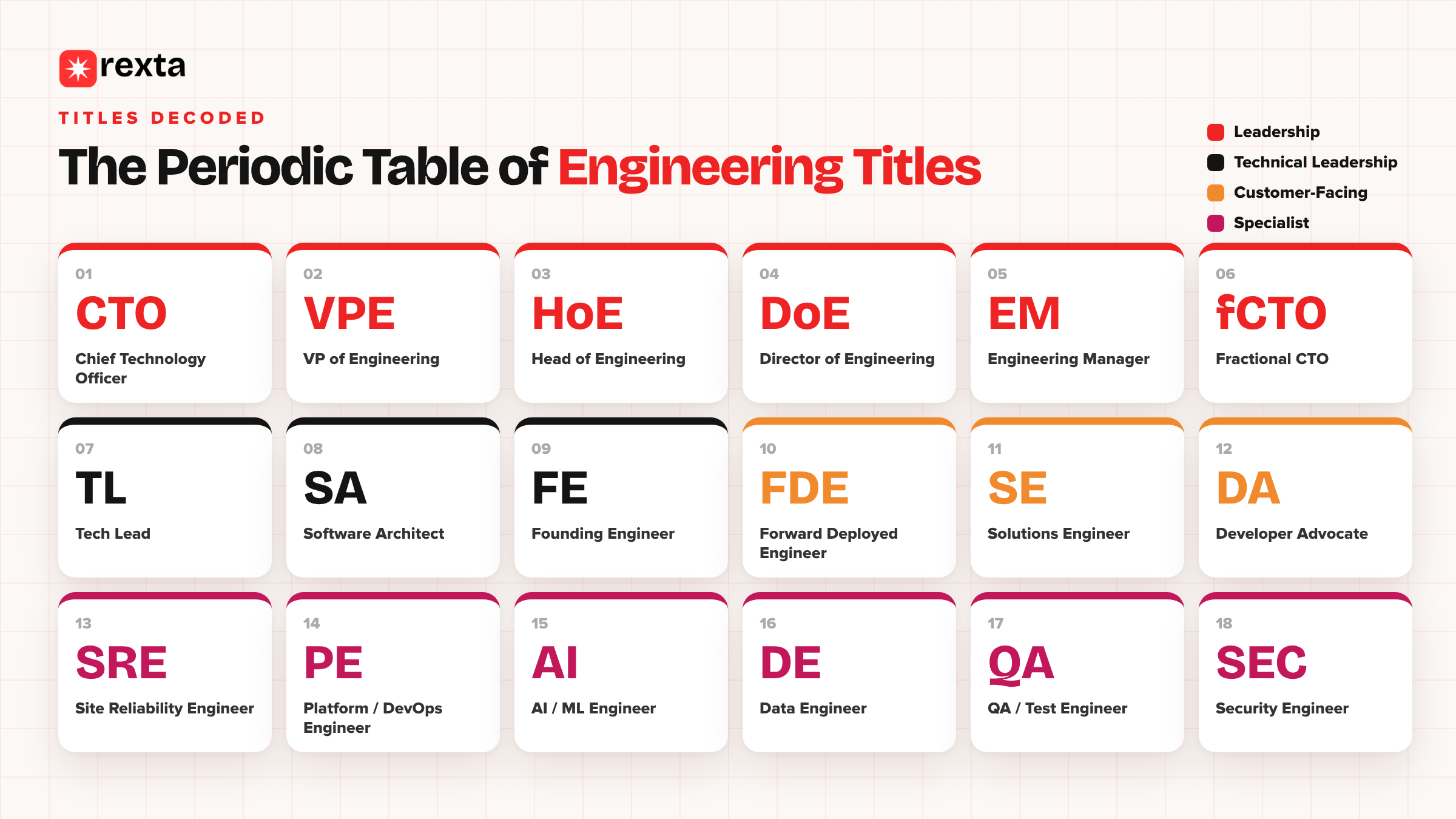
Leadership and executive roles
CTO (Chief Technology Officer): owns the company's technology vision and strategy. At a startup, the CTO may still write code every day; at a large company, they rarely do.
VP of Engineering: runs the engineering organisation day to day, covering people, delivery, hiring and process. Where the CTO focuses on what technology to build, the VP focuses on how the team builds it.
Head of Engineering: leads engineering at smaller companies, often before there's a VP or CTO.
Director of Engineering: manages several teams and their managers.
Engineering Manager: leads a single team's people, growth and delivery.
Fractional CTO: a part-time CTO for companies that need senior technical leadership but not a full-time executive.
Technical leadership
Tech Lead: guides a team's technical decisions while still writing code. Often a responsibility given to a senior engineer rather than a separate level.
Software Architect: designs how large systems and their parts fit together.
Founding Engineer: one of the first engineers at a startup, building the product from the ground up and often wearing many hats.
Customer-facing engineering
Forward Deployed Engineer (FDE): works directly with customers, sometimes on-site, to build and deploy solutions tailored to their needs. The role was made famous by Palantir and has become popular again with AI companies, where getting a product working inside a customer's real systems takes serious engineering.
Solutions Engineer: a technical expert who helps customers understand, evaluate and adopt a product, often working alongside sales.
Developer Advocate: helps developers succeed with a product through documentation, content, talks and community.
Specialist roles
Site Reliability Engineer (SRE): keeps systems fast, stable and available, and makes sure problems are caught before users notice.
DevOps / Platform Engineer: builds the tools, pipelines and infrastructure that other engineers rely on.
AI / ML Engineer: builds products and features powered by AI models, from recommendation systems to AI assistants.
Data Engineer: builds the pipelines that collect, clean and move data so it can be used for analysis and AI.
QA / Test Engineer: makes sure software works as expected before it reaches users.
Security Engineer: protects systems and data from threats.
How to move up the ladder
Promotions rarely come from writing more code. They come from showing you can handle a bigger scope. A few habits make the biggest difference:
Own outcomes, not just tasks. Don't stop at "I finished my ticket." Ask whether it solved the problem it was meant to solve.
Get comfortable with unclear problems. The higher you go, the less clearly problems are defined. Practise turning vague requests into clear plans.
Communicate well. Clear writing, good documentation and simple explanations matter more at every level.
Make others better. Review code thoughtfully, share what you know and mentor newer engineers.
Understand the business. Know why your work matters to customers and to the company, not just how it works.
Make your impact visible. Keep track of what you've delivered and the difference it made. Good work that nobody knows about rarely gets promoted.
Need experienced engineers on your project?
Our team brings senior-level engineering to every build, from architecture to launch. Get started today!
Final thoughts
Job titles in software can look like a confusing maze, but the idea behind them is simple. As engineers grow, they take on bigger problems, work through more uncertainty and have a wider impact on the people around them.
Whether you're writing your first line of code or deciding between the Staff and Engineering Manager paths, the same advice applies. Focus on growing your impact, and the titles tend to follow.
If you want to see how modern engineering teams actually work day to day, read our piece on the SDLC in the AI era.
Frequently Asked Questions
How long does it take to become a Senior Software Engineer?
Usually around five years, but it varies widely. Some engineers get there in three or four years by working on challenging problems and taking on ownership early. Others take longer. Growth depends on the scope of your work, not just the time you spend.
Is a Staff Engineer higher than a Senior Engineer?
Yes. Staff is the next level up on the individual contributor track. While a senior engineer typically owns systems within a team, a staff engineer solves problems that span multiple teams and helps set technical direction.
Is a Staff Engineer higher than an Engineering Manager?
Not exactly. They're on different tracks. At many companies, a Staff Engineer and an Engineering Manager sit at a similar level with similar pay. One leads through technical expertise; the other leads through people.
Do all companies use the same levels?
No. Titles and levels vary between companies, and especially between startups and large tech companies. A "Senior Engineer" at a small startup might be considered mid-level elsewhere. Look at the scope of the role, not just the title.
What's the difference between a Tech Lead and a Staff Engineer?
A Tech Lead guides the technical direction of a single team and is usually a role given to a senior engineer. A Staff Engineer is a level, and typically works across several teams on broader technical problems.
What does a Forward Deployed Engineer do?
A Forward Deployed Engineer works directly with customers, often on-site, to build, customise and deploy software that fits their specific needs. It combines strong engineering skills with close customer collaboration.
What's the difference between a CTO and a VP of Engineering?
The CTO focuses on technology vision and strategy: what the company should build and why. The VP of Engineering focuses on running the engineering organization: how the team builds it, including people, process and delivery. At smaller companies, one person often does both.
Can I go back to coding after becoming a manager?
Yes. Many engineers move into management and later return to the individual contributor track. Experience on both sides often makes people stronger in whichever role they choose.
Reactions
Stay in the loop
Get notified when we publish a new blog post. No spam, just insights and updates from the Rexta Technologies team.
Related Posts
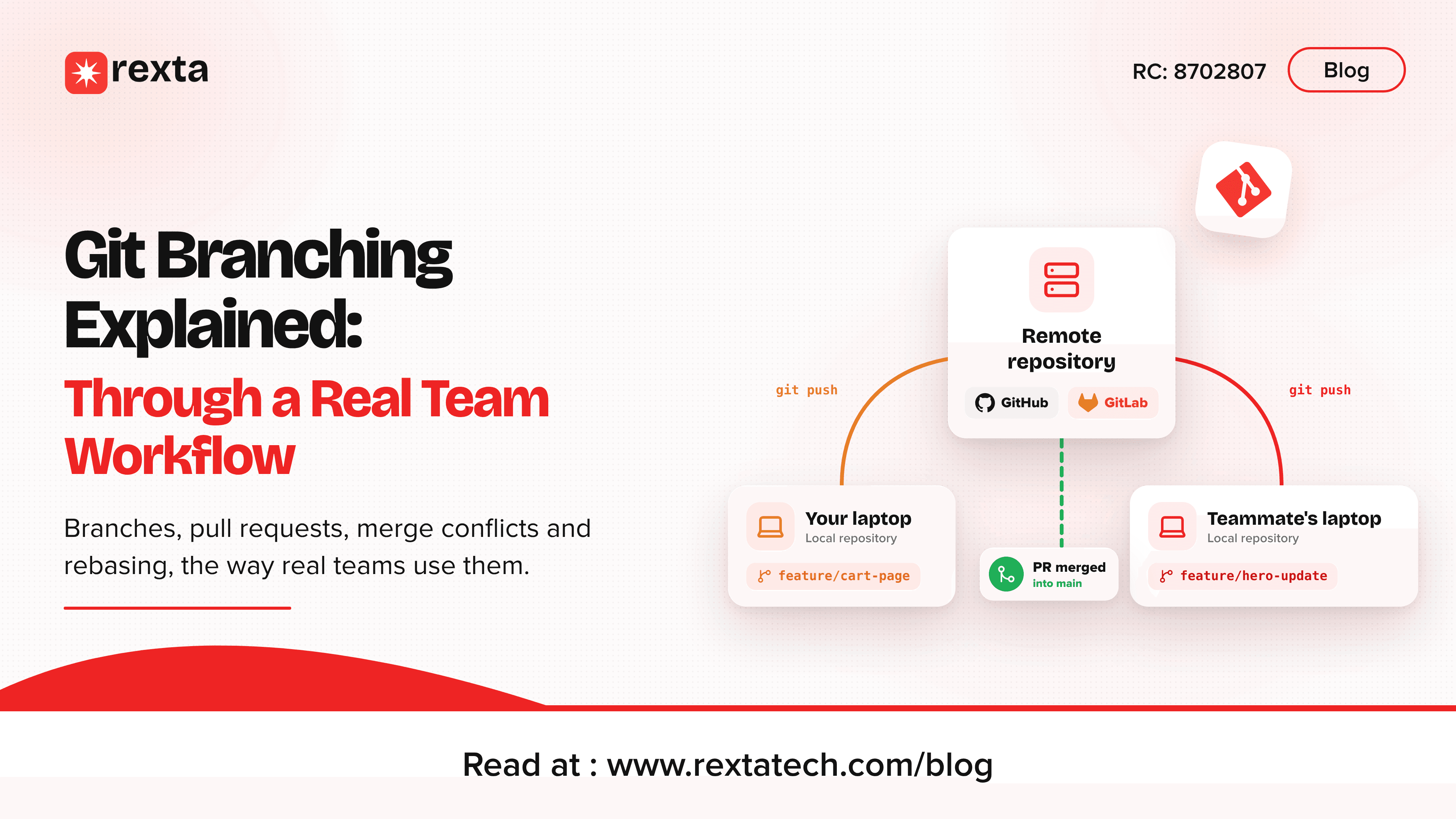
Git Branching Explained Through a Real Team Workflow
Working with Git becomes more interesting when multiple developers contribute to the same codebase. Follow a realistic team workflow and see how branches, pull requests, merge conflicts and rebasing actually work in practice.
25 Nov 2026
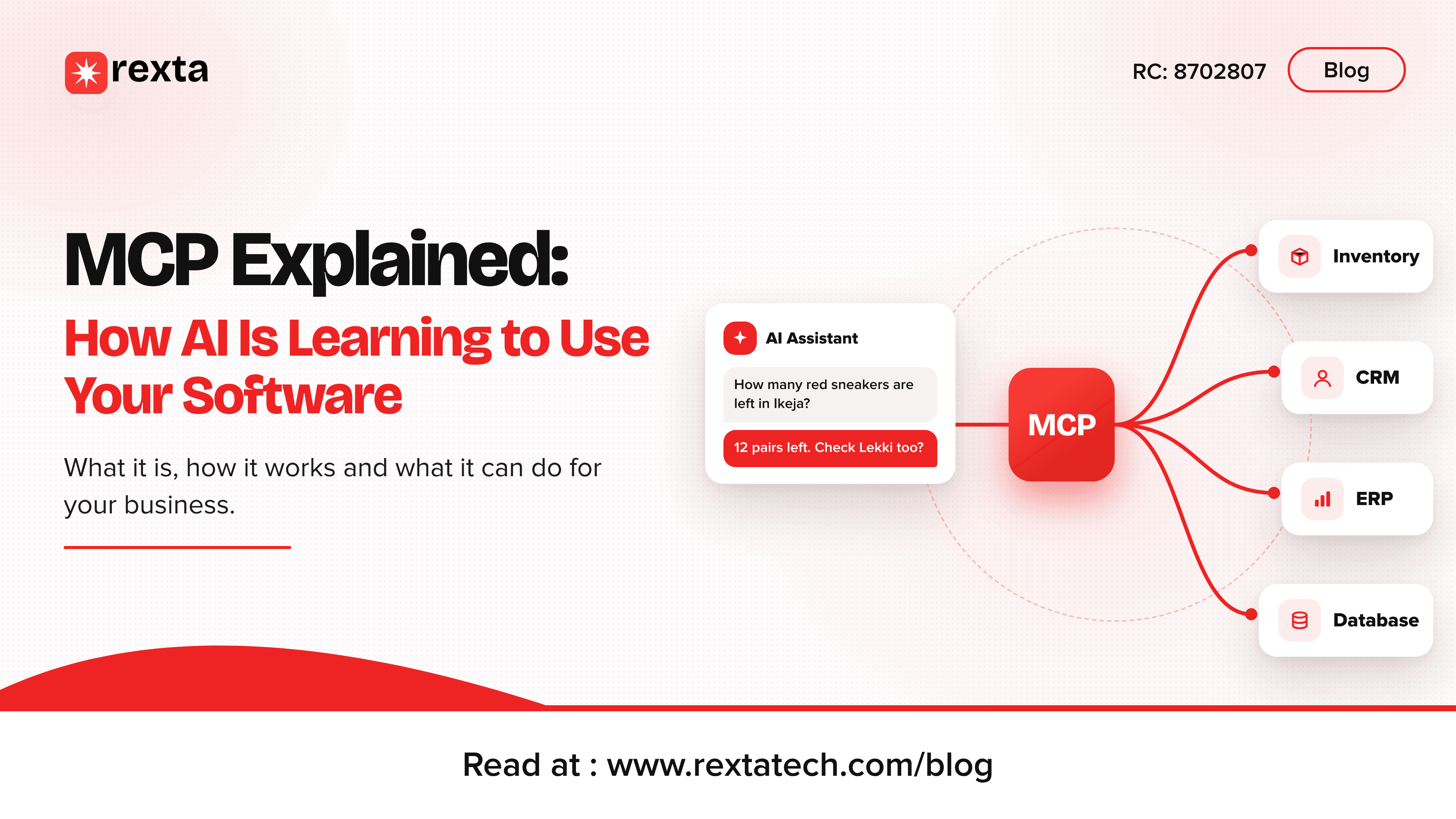
MCP Explained: How AI Is Learning to Use Your Software
AI assistants are smart, but most of them can't see your business. MCP is the open standard changing that. Here's what it is, how it works, and what it could do for your business.
23 Nov 2026

Is Your Website Ready for Black Friday?
Black Friday can bring more visitors and potential customers to your website. Use this practical checklist to review your website's speed, mobile experience, checkout, security, and readiness for increased traffic.
23 Nov 2026

ERP for Business Efficiency: What It Does and How to Choose the Right One
Discover how ERP systems connect business operations, reduce manual work, and improve efficiency. Learn what to look for when choosing between an off-the-shelf, customized, or bespoke ERP solution.
16 Nov 2026